

If you care about clean eating, your cookware deserves the same level of scrutiny as your groceries. The pan under your dinner can matter just as much as the ingredients in it.
You don't need to panic or throw out your whole kitchen. You do, however, need a sharper filter. When people talk about “toxic cookware,” two issues stand out most clearly: PFAS in nonstick coatings and lead in certain ceramics or metal cookware. Once you separate those two risks, the choices get much easier.
Why cookware chemicals get so much attention
Cookware safety gets confusing fast because not every material raises the same concern. A scratched nonstick skillet, a decorative imported bowl, and a stainless steel stockpot do not belong in the same risk category. Yet they often get discussed as if they do.
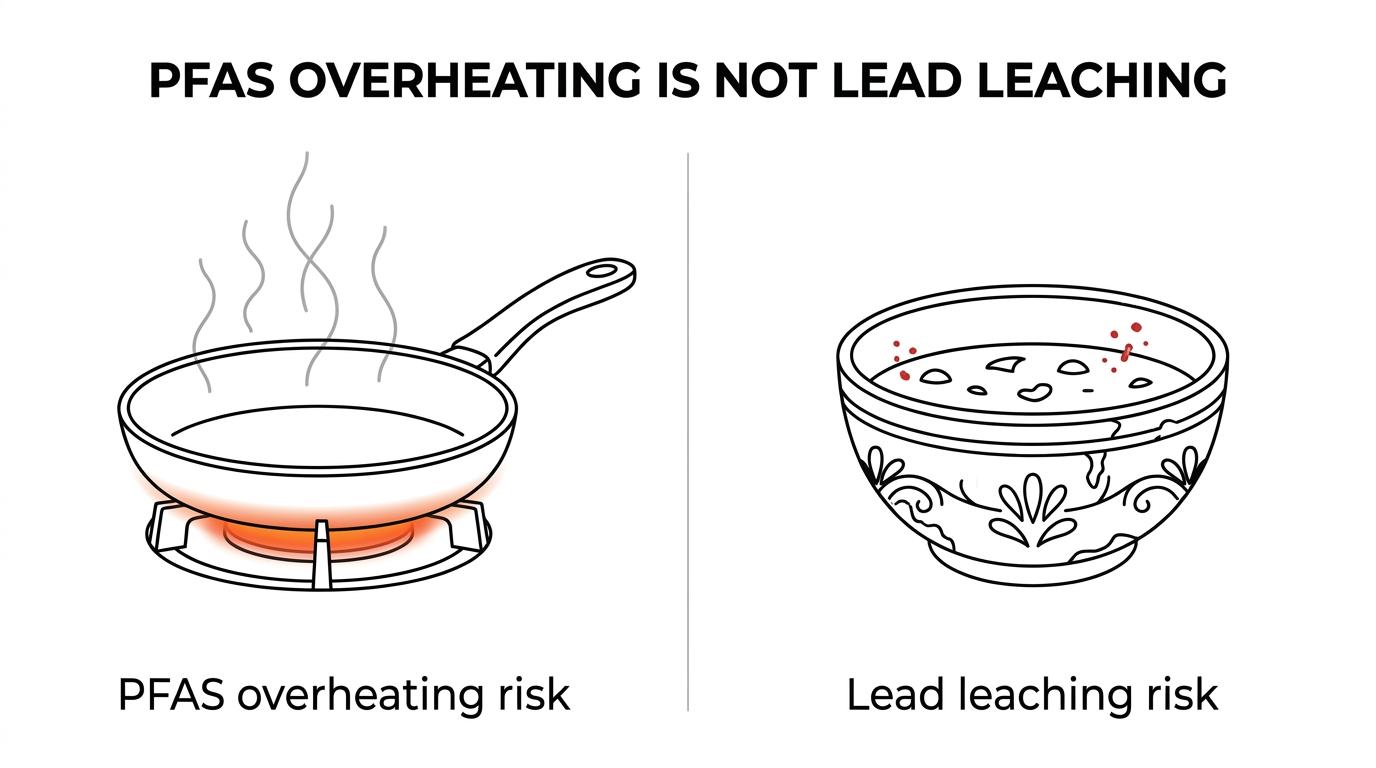
The strongest evidence-backed concerns are pretty specific. Official guidance points to two main things you should watch closely:
- Overheating nonstick cookware, especially when the pan is empty
- Using cookware or serving pieces that may leach lead, especially imported, decorative, antique, handmade, or damaged items
That distinction matters. It keeps you focused on the risks that are actually supported by public health agencies instead of broad internet fear.
PFAS in nonstick cookware: what official agencies say
PFAS is a large family of chemicals used in many industrial and consumer applications. In cookware, the term usually comes up because many nonstick coatings are made with PFAS. Health Canada says PTFE is the most commonly used PFAS in nonstick coatings.
That sounds alarming at first, but the full picture is more nuanced. The FDA says PFAS have been authorized for certain food-contact applications since the 1960s. It also says that in nonstick pots and pans, PFAS molecules are polymerized and applied at very high temperatures, creating coatings that are tightly bound to the cookware. According to the FDA, studies show negligible migration of PFAS from these coatings into food.
So if you have a modern nonstick pan and use it as directed, the concern is not exactly the same as “chemicals leaching into your eggs.” The FDA’s current exposure concern is focused more on grease-proofing used in paper and paperboard food packaging.
Still, nonstick cookware is not a free pass for careless cooking.
- FDA says: PFAS in nonstick coating applications are tightly bound to the cookware surface, with negligible migration to food.
- FDA says: Its current PFAS exposure concern is mainly tied to grease-proofing in paper and paperboard food-contact applications.
- Health Canada says: Many nonstick coatings are made with PFAS, and PTFE is the most common one.
- Health Canada says: Overheating nonstick cookware can create irritating or poisonous fumes, especially when an empty pan is heated.
- Health Canada says: Nonstick cookware should not be used above 260 °C (500 °F).
This is where smart use matters more than fear-based messaging. A nonstick pan is most likely to become a problem when you misuse it, not when you make a reasonable weeknight omelet over moderate heat.
And it's important to distinguish from Teflon (PTFE) and non-stick pans. Just because something is "non-stick" doesn't mean that it's made out of Teflon.

How to use nonstick cookware more safely at home
If you already own nonstick cookware, you can lower your risk right away by changing how you use it. You do not have to guess. The official advice is clear and practical.
The biggest rule is simple: do not preheat an empty nonstick pan. Empty pans heat quickly, and that makes it easier to overshoot safe temperatures before you notice. If you are cooking with nonstick, get your oil or food in the pan early and keep the heat moderate.
A few habits go a long way:
- Low to medium heat
- No empty-pan preheating
- Keep it under 500 °F
- Use wood, silicone, or other non-abrasive utensils
- Replace pans with deep scratches, peeling, or worn coatings
- Turn on ventilation when cooking
This is also a good place to be honest about your cooking style. If you often sear at high heat, broil, or forget pans on the stove, traditional nonstick may not be the best everyday choice for you. A material that tolerates higher temperatures with less babysitting may fit your kitchen better.
Lead risks in cookware, ceramics, and imported metalware
Lead deserves very serious attention because the FDA states there is no known safe level of exposure to lead. That changes the conversation. Even small, repeated exposure from cookware or serving pieces is worth avoiding.
The FDA has flagged some imported cookware made from aluminum, brass, and certain aluminum alloys as possible lead sources.
State health guidance points to another category many people overlook: ceramics and pottery. New York State warns that handmade ceramics, decorative pottery, damaged or worn ceramics, aluminum cookware, and decorative metalware marked “not for food use” may contain lead. Antique and patterned items can also be risky if you do not know how they were made.
That means a beautiful bowl, a hand-painted casserole dish, or a market-find teapot is not automatically safe just because it looks charming or sturdy.
|
Cookware or item |
Main concern |
What official guidance flags |
Smarter move |
|---|---|---|---|
|
Traditional nonstick cookware |
PFAS coating and overheating fumes |
Health Canada warns against overheating, especially empty pans |
Use moderate heat and avoid preheating empty |
|
Imported aluminum or brass cookware |
Lead leaching |
FDA flagged some imported items and certain alloys in testing |
Buy from trusted sources with clear material disclosure |
|
Handmade, decorative, antique, or damaged ceramics |
Lead in glazes or materials |
New York State warns these may contain lead |
Use only food-safe verified pieces for cooking and serving |
|
Decorative metalware marked not for food use |
Lead exposure |
New York State says avoid using these with food |
Keep them decorative only |
|
Stainless steel cookware |
Lower lead concern |
New York State lists it as less likely to contain lead |
Good option for daily cooking |
This is one area where “old-fashioned” and “artisanal” are not always positives. If a piece is handmade, vintage, imported, or decorative, you should ask harder questions before it touches your food.
Safer cookware materials for everyday cooking
If your goal is to cut back on questionable coatings and reduce uncertainty, the easiest move is to build your kitchen around straightforward, well-identified materials. Stainless steel is a strong place to start, and it gets a specific vote of confidence from New York State as a cookware choice less likely to contain lead.
Many home cooks also shift toward carbon steel, cast iron, and enameled cast iron because these materials can handle everyday cooking without synthetic nonstick coatings. That does not mean every product on the market is equally well made. It does mean you can choose cookware categories that fit a lower-chemical, higher-durability approach.
What matters most is not just the material name on the product page. It is how clearly the seller tells you what the item is made from, how it should be used, and whether it is actually intended for food contact.
When you shop, look for transparency instead of marketing fluff.
- Material disclosure: Choose cookware with a clearly stated material, not vague terms like “alloy metal.”
- Food-use statement: Skip anything decorative, ornamental, or unclear about food contact.
- Care instructions: Good cookware should come with heat limits, utensil guidance, and cleaning directions.
- Seller credibility: Prefer products with traceable manufacturers and consistent product details.
- Surface condition: Avoid chipped enamel, worn ceramics, cracked glazes, or flaking coatings.
If a listing looks polished but tells you very little, that is a warning sign. A pan should not feel mysterious.

What to check before you buy cookware
A safer kitchen starts with better screening. You can make strong choices in minutes if you know what to look for.
First, pay attention to where and how you will use the cookware. If you want high-heat searing, carbon steel or cast iron may make more sense than traditional nonstick. If you want a low-maintenance soup pot or sauté pan, stainless steel or enameled cast iron can be a solid fit. Matching the material to the job keeps you from pushing cookware outside its limits.
Second, separate cooking tools from serving or decorative pieces. Plenty of people use imported bowls, antique pottery, hand-painted dishes, or market finds for everyday meals without realizing the risk. If a piece is decorative, unknown in origin, or not clearly labeled for food use, treat it like decor.
Third, be extra careful with bargain cookware that hides basic information. Price alone does not tell you whether something is safe, but missing details should stop the sale.
Here are the biggest red flags:
- No clear material listed
- No stated heat limit for nonstick
- Decorative or souvenir-style ceramics
- Chipped or cracked glazed surfaces
- Antique cookware with unknown history
- Imported metal cookware with unclear composition
- Listings that avoid naming the manufacturer
You also do not need to replace everything overnight. Start with the pieces you use most often. Your everyday frying pan, skillet, saucepan, and food storage or serving pieces will shape your regular exposure far more than the roasting dish you use twice a year.
A practical reset often looks like this: keep nonstick only for tasks that truly benefit from it, use it gently, and replace worn pieces; rely on stainless steel, carbon steel, or cast iron for higher-heat daily cooking; keep decorative or uncertain ceramics out of food service unless they are clearly verified as food safe.
That approach is realistic, not extreme. It respects what official guidance actually says, and it gives you a kitchen you can trust more every day.
If you want cleaner cookware decisions, look past hype and stick with plain questions: What is it made of? Is it meant for food? Can the seller prove it? Will your cooking style push it too hot? Those answers will do far more for your health than a trendy label ever will.