

If you want cookware that lasts, your utensils matter almost as much as your pans. A good wooden spoon or spatula can help you protect delicate cooking surfaces, keep meals moving smoothly, and cut down on the wear that comes from harder tools.
That is why so many home cooks search for the best wooden utensils for nonstick pans, carbon steel, and enameled cast iron. Wood is gentle, practical, and comfortable to use. Still, not every wooden utensil is a smart buy. The safest choice comes down to wood type, surface finish, construction, and how you care for it over time.
Why wooden utensils are safe for cookware surfaces
Wooden utensils are widely recommended for cookware that can scratch or wear down with rough contact. If you cook with nonstick pans, this matters even more. Official guidance on coated cookware consistently points toward nonscoring or nonscratching utensils, and wood fits that need well.
Metal tools can nick a coating, while very hard plastic can leave marks over time. A smooth wooden turner or spoon is much gentler. Health Canada advises using non-metal cooking utensils to help prevent surface damage, and MedlinePlus recommends wood, bamboo, or silicone over metal or hard plastic for the same reason.
That benefit is not limited to traditional nonstick cookware.
|
Cookware type |
Why wooden utensils work well |
What to watch for |
|---|---|---|
|
Nonstick pans |
Reduce scratching and coating wear |
Do not use sharp-edged or cracked wood |
|
Carbon steel pans |
Gentle on seasoning and less noisy in the pan |
Avoid soaking utensils that may warp or roughen |
|
Enameled cast iron |
Less likely to chip or mark enamel than metal tools |
Check for worn edges that can drag |
|
Stainless steel |
Comfortable for stirring and sautéing |
Wood will not scrape browned bits as aggressively as metal |
Wood is especially appealing if you are moving away from synthetic nonstick habits and building a cleaner kitchen around non-toxic cookware and everyday stovetop cooking. Terra Cove Home’s teak wood utensils fit that upgrade well because they pair naturally with non-toxic cookware and everyday stovetop cooking.

What makes a wooden utensil food-safe and durable
A wooden utensil can be safe for cookware and still be a poor choice for food contact if the material or finish is wrong. That is the part many shoppers miss.
FDA Food Code guidance gives a useful standard here. It generally limits wood as a food-contact surface in many settings, with specific exceptions. One of those exceptions allows hard maple or an equivalently hard, close-grained wood for certain utensils and kitchen items, including rolling pins, salad bowls, and chopsticks. That tells you something valuable: dense, close-grained hardwoods are the better category to shop.
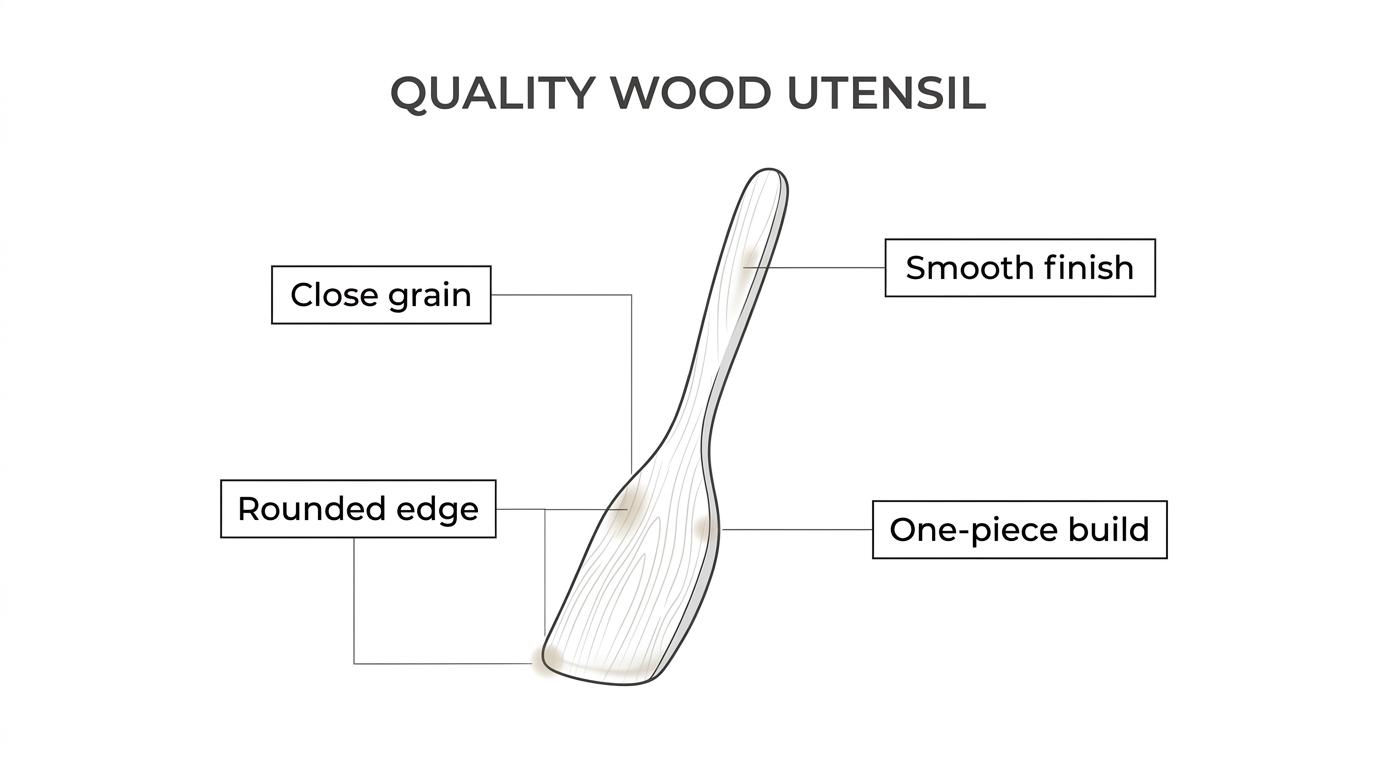
For home use, this does not mean every wood utensil on the market is equal. You want a utensil made from a hard, smooth, stable wood that resists deep grooves and excess moisture absorption. You also want a finish that is food-safe and simple, not a mystery coating that can wear off into your food.
When you compare options, focus on the basics that affect safety and lifespan:
- Wood species: hard maple or another dense, close-grained hardwood
- Surface finish: smooth, food-safe oil or wax finish
- Construction: one-piece design with no glued weak points
- Edges: rounded and sanded, never sharp or splinter-prone
- Coating: no peeling paint, heavy lacquer, or decorative film
Teak is a popular choice in this category because it is dense, durable, and tends to hold up well in busy kitchens. That is one reason many cooks gravitate toward teak utensil sets when they want a polished, long-lasting option. If you are shopping Terra Cove Home’s wooden utensils, that material choice speaks directly to durability and daily use.
How to choose wooden utensils for nonstick pans and daily cooking
If your main goal is protecting cookware, shape matters as much as material. A spoon with a rough edge can still drag across a pan. A spatula that is too thick can feel clumsy. The best wooden utensils for cooking are shaped for actual kitchen work, not just shelf appeal.
Start with the pieces you will reach for most often. For most home kitchens, a small set covers almost everything without filling a crock with tools you never touch.
A practical starter set usually includes:
- flat turner
- cooking spoon
- slotted spoon
- spatula or scraper spoon
A flat turner is great for eggs, pancakes, and delicate fish in nonstick or enameled pans. A broad cooking spoon handles sauces, grains, soups, and sautéed vegetables. A slotted spoon gives you control when lifting food out of liquid. A scraper-style spoon is useful for stirring thicker dishes while still staying gentle on the pan.
You should also pay attention to edge profile. Rounded edges are safer for coated cookware. Thin, sharp corners may act like a scraper, especially when pressure is applied. That is why many experienced cooks prefer a wooden spatula with a slightly tapered but softened front edge.
Handle length deserves a quick look too. A short handle works fine for a skillet. A deeper sauté pan or Dutch oven benefits from more reach. If you cook family meals often, choose utensils that feel balanced in your hand and do not force you to grip tightly when stirring heavier foods.

Wooden utensils and nonstick cookware safety are linked, but not identical
This is where smart cookware care comes in. Wooden utensils help protect the surface of nonstick cookware, but they do not solve every nonstick safety issue.
Official guidance on nonstick cookware still stresses heat control. Health Canada warns that nonstick cookware may release irritating or poisonous fumes if overheated, including situations where an empty pan is left on a burner. That same guidance says not to preheat empty nonstick cookware and not to use it above 260°C or 500°F. MedlinePlus also advises using nonstick cookware only at low or medium heat and never leaving it unattended at high heat.
So yes, wooden utensils are a safe choice for nonstick pans because they reduce scratching. Still, safe nonstick use also means gentler heat, careful cleaning, and replacing pans when the coating is badly worn. If you want fewer tradeoffs, many home cooks now reserve nonstick for a small number of tasks and rely more heavily on carbon steel or enameled cast iron for daily cooking.
That shift makes quality wooden utensils even more useful. The same spoon that protects a coated skillet also feels right in a carbon steel pan or an enamel roasting dish. You buy it once, then use it across your whole kitchen.
Signs a wooden utensil is high quality before you buy
Online photos do not always tell the full story, so you need a quick filter. Look closely at the grain, finish, and shape.
High-quality wooden utensils usually have a tighter, more even grain and a smooth surface with no fuzzy patches. They should look finished but not plastic-like. If a utensil appears heavily coated, very glossy, or decorative in a way that hides the wood itself, pause before buying.
Use this checklist when comparing products:
- Smooth feel: no rough sanding marks or dry splinters
- Close grain: fewer open pores and fewer visible weak spots
- Solid build: no cracks near the neck or bowl
- Balanced shape: comfortable width, useful handle length, good control
- Kitchen-first design: made for stirring, flipping, and serving, not just display
This is where a curated kitchenware shop can save you time. Instead of sorting through generic marketplace listings, you can choose from utensils selected to match clean cooking goals and durable cookware. Terra Cove Home’s teak wood utensils make sense for that kind of buyer: someone who wants practical tools that also look at home beside carbon steel pans and enameled cast iron.

How to clean and maintain wooden utensils safely
Wooden utensils are low maintenance, but they are not no-maintenance. A few simple habits keep them smooth, clean, and safe to use.
Wash them by hand with mild soap and warm water. Dry them soon after washing rather than letting them sit wet in the sink. Long soaking can swell the fibers and roughen the surface. Dishwashers are usually too harsh for wood because repeated heat and water exposure can lead to cracking, fading, or warping.
If the wood starts to look dry, a light coat of food-safe mineral oil or a food-safe board wax can help restore the surface. This does not need to be a weekly task. Just do it when the utensil looks thirsty or chalky.
You should also know when to retire one.
- Deep grooves
- Persistent odors
- Splintering edges
- Cracks in the bowl or handle
- Dark stains that do not wash out
MedlinePlus notes that wooden kitchen surfaces should be thrown out when they are very worn or have deep grooves. That advice is practical for utensils too. Once the surface gets heavily grooved or damaged, cleaning becomes less reliable and the utensil becomes harder on your cookware.
When wooden utensils are the best choice and when another material helps more
Wood is an excellent all-purpose choice, but you do not need it to do every job. If you are trying to build the smartest utensil set, think in terms of strengths.
Wood shines when you are sautéing, stirring soups, folding grains, serving pasta, or flipping softer foods in cookware you want to protect. It feels stable, stays relatively cool in hand, and does not clang against pans. That alone makes cooking calmer and more controlled.
Silicone can be better when you need to scrape a bowl clean or work with very sticky batters and sauces. Metal still has a place for tasks that need a firmer edge, though it is best kept away from delicate surfaces.
The point is not to own one material only. The point is to let wood handle the jobs where cookware protection matters most.
If your kitchen priorities are non-toxic cookware, longevity, and a more intentional cooking setup, wooden utensils deserve a central spot. A well-made teak spoon or turner from Terra Cove Home is not just a nice accessory. It is a practical upgrade that helps your pans last longer and makes daily cooking feel more grounded, simple, and reliable.